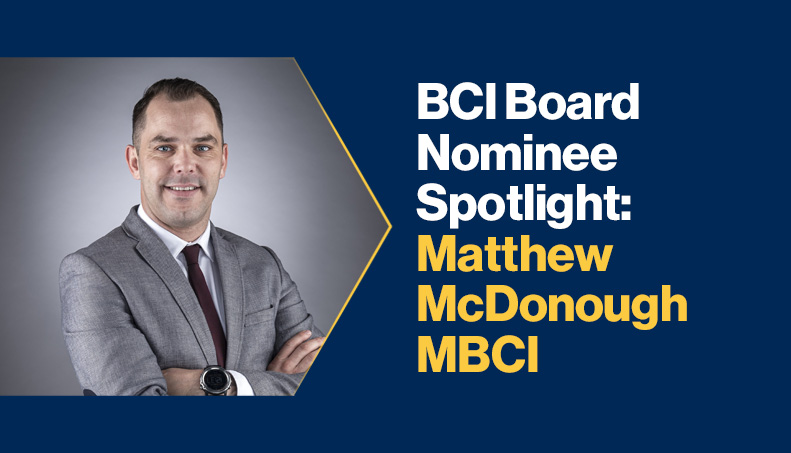
BCI Board Nominee Spotlight: Matthew McDonough MBCI
About the nominee
I am an organizational resilience professional with experience across BCM, crisis management and emergency management, built in very different environments, including a US major university based in Qatar (Texas A&M), UK defence & aviation (including nuclear submarines and later digital intelligence), a Saudi government giga project authority, and now a Qatari research university. In each I have built and matured practical, risk-informed capabilities rather than inheriting an existing one.
An MBCI, elected in 2022, I served as a BCI Awards Judge for 2026, assessing entries against the BCI standards. I am also a qualified assessor and verifier of accredited training programmes, which shapes how I evaluate evidence and professional standards generally.
BCI's leadership has said the board needs to reflect a membership that is now global and varied in background. I want to bring a Gulf and multi-sector perspective to that table, built on direct practitioner experience rather than theory, and tested this year from the judge's position, as well as my own desk.
Prior board and governance experience
While serving as BCM Manager for BAE Systems' submarines business unit in the UK, I established the BCM Steering Committee, bringing together the board and guiding its direction on continuity priorities, risk escalation and our programme assurance in a high consequence, heavily regulated environment.
Why serve on the BCI board?
I have an interest in serving a community of BCM professionals who have come from a very different path than the majority of BCM professionals I meet, who have financial operational resilience experience. I believe I bring a wealth of diversity to the board, that will represent a community of BCM professionals who have helped to play a role in my journey.
My career has moved through UK defence, Saudi industrial government, and Gulf higher education, and each move has forced me to rebuild credibility and capability from scratch in a new context.
As a BCI Awards Judge this year, I already see organizations who demonstrate real capability under pressure, and others who produce documentation that performs well on paper but has not been tested. That same judgement, applied to the Institute's own strategic choices, is what I would bring to the board table.
I would also bring direct, current standards practice. ISO 22301, 22361 and 31000 are tools I use weekly, and I bring a perspective from outside the UK and North American base of the profession.
What skills and experience do you bring to the BCI Board?
In leadership, I have built and led resilience functions in different organisational cultures, each with different governance norms and different levels of maturity.
I established and guided the BCM Steering Committee for BAE Systems' submarines business, a board-level governance body for continuity and risk escalation in a high-consequence, heavily regulated industry. I report formally into audit, risk and compliance structures at HBKU, and I am a qualified assessor and verifier of accredited training programmes, which gives me direct experience evaluating evidence against a professional standards framework.
I built the staffing and resourcing business case for my current team, covering headcount, role structure and the case for technology support, which required making a financial argument to non-specialist decision makers.
In industry and technical expertise, I have direct working knowledge of the GPG, ISO 22301, ISO 22313, ISO/TS 22317, ISO 22320, ISO 22361, ISO 22398 and ISO 31000, and of NFPA 1660 as a comparator standard, plus current insight into how the profession's own GPG is applied in practice through judging the BCI Awards.
I also have experience identifying systemic gaps between policy and practice and converting that into a governance-level corrective action rather than a local fix.