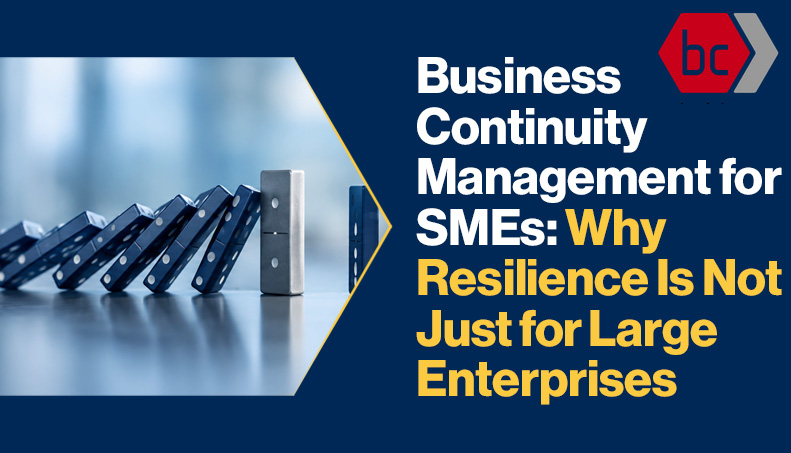
Business Continuity Management for SMEs: Why Resilience Is Not Just for Large Enterprises
When disruption occurs, preparedness becomes invaluable
A cyberattack encrypts critical systems. A power outage disrupts operations. A key supplier suddenly becomes unavailable.
Many small and medium-sized enterprises (SMEs) assume that such scenarios primarily affect large corporations. However, reality tells a different story. Limited resources, specialized personnel, and critical dependencies often make SMEs particularly vulnerable to operational disruptions. This is where Business Continuity Management (BCM) comes into play.
What is Business Continuity Management?
Organizations cannot always prevent disruptions, crises, or incidents. What they can do is prepare for them.
Business Continuity Management is a holistic management approach designed to strengthen organizational resilience and ensure that critical products, services, and business processes can continue operating during a disruption or be recovered within acceptable timeframes.
At its core, BCM seeks to answer key questions before an incident occurs:
- Which business processes are critical?
- What would be the impact of a disruption?
- Which resources are essential for maintaining operations?
- Who is responsible for decision-making during a crisis?
- What recovery strategies are available?
Resilient organizations do not rely on improvisation. They rely on preparation, planning, and tested response capabilities.
Why BCM Matters for SMEs
- Cyber threats affect organizations of all sizes
Cyberattacks, ransomware, and phishing campaigns are no longer risks faced only by large enterprises. In many cases, SMEs are targeted because they often have fewer resources dedicated to cybersecurity and incident preparedness. The question is no longer whether an incident will occur, but how quickly an organization can respond and recover. - Downtime impacts both revenue and reputation
When critical systems or processes become unavailable, the consequences can be immediate. Orders may be delayed, customer service disrupted, and contractual commitments missed.Beyond financial losses, prolonged disruptions can damage customer trust and stakeholder confidence. - Business dependencies continue to grow
Most organizations depend on cloud providers, external service providers, suppliers, and digital infrastructure to support day-to-day operations.As supply chains and technology ecosystems become increasingly interconnected, disruptions affecting a single critical partner can have far-reaching consequences throughout the organization. Effective BCM therefore considers both internal processes and external dependencies. - People-related risks are often overlooked
In many SMEs, critical knowledge resides with only a small number of individuals. Unexpected absences, resignations, or other workforce disruptions can significantly impact business operations. Business Continuity Management helps organizations identify key personnel dependencies, document critical knowledge, and establish succession and backup arrangements. - Crises require rapid and informed decision-making
The first hours of a disruption are often the most critical. Without clearly defined roles, communication procedures, and response strategies, uncertainty and delays can amplify the impact of an incident. BCM provides the structure needed to make effective decisions under pressure.
Common Misconceptions About BCM
“Business Continuity Management is only for large corporations.”
In reality, SMEs often have the most to gain from structured preparedness. While larger organizations may have greater resources to absorb disruptions, smaller businesses can be significantly more affected by prolonged outages.
“We have backups, so we're covered.”
Backups are important, but they represent only one element of resilience. BCM goes further by addressing people, processes, suppliers, facilities, communication, governance, and recovery capabilities.
“We've never experienced a major incident.”
Most disruptive events occur unexpectedly. Organizations that begin making critical decisions only after a crisis has started often lose valuable time.
BCM takes a proactive approach by preparing for disruption before it happens.
A Practical Starting Point for SMEs
Implementing BCM does not need to begin with a complex program. Even a few structured steps can significantly improve organizational resilience.
- Identify critical business processes
Determine which products, services, and processes are essential to maintaining operations. - Assess the potential impact of disruptions
Evaluate the consequences of losing systems, personnel, facilities, suppliers, or technology services. - Understand critical resources and dependencies
Identify the people, technology, information, facilities, and third parties that support business-critical activities. - Define roles and responsibilities
Establish clear accountability for decision-making and incident response. - Develop continuity and recovery plans
Document the actions required to maintain or restore critical operations during a disruption. - Test and review regularly
Business continuity plans are only effective if they are regularly exercised, validated, and updated.
Conclusion: Organizational Resilience Starts with Preparation
Business Continuity Management is not a matter of company size. It is a strategic approach that enables organizations to strengthen resilience and maintain operational capability during times of disruption.
For SMEs in particular, understanding risks, dependencies, and critical business processes can make a significant difference when an incident occurs. Instead of reacting under pressure, resilient organizations are prepared to respond effectively, minimize disruption, and protect their customers, employees, and stakeholders.
Ultimately, the question is not whether a disruption will occur, but how well prepared your organization is when it does.
Organizations that invest in preparedness today are better positioned to navigate uncertainty and emerge stronger tomorrow.
The Business Continuity Institute (BCI) promotes professional practice, knowledge sharing, and global standards that help organizations build resilience and continuity capabilities in an increasingly uncertain world.
More on