From Plan Custodian to Strategic Influencer: 3 Ways to Elevate Your Role in Resilience

Business continuity and resilience professionals have traditionally been responsible for building plans, conducting exercises and making sure the organization is prepared for disruption.
That work remains essential. But the role is evolving.
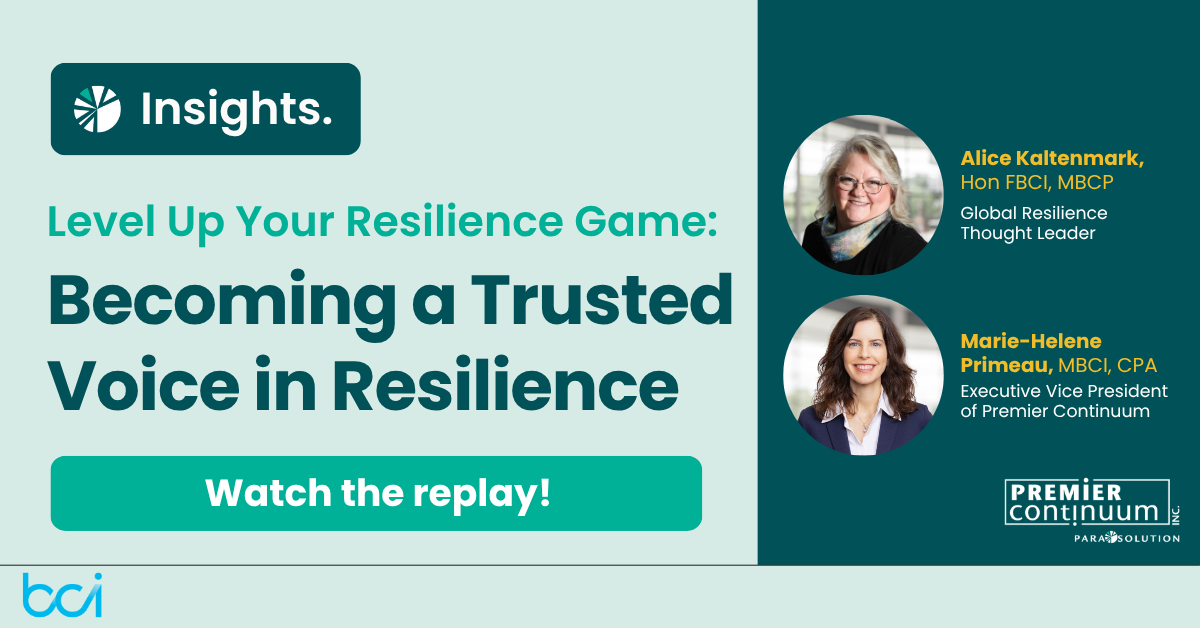
During a recent Premier Continuum Insights webinar, Alice Kaltenmark, FBCI, MBCP, a business resilience expert with more than 40 years of experience in business continuity and disaster recovery and BCI board member, joined Marie-Helene Primeau, MBCI, CPA, ISO 22301 Lead Auditor, Executive Vice President at Premier Continuum and a business continuity and resilience practitioner with more than 25 years of experience.
Together, they explored how resilience professionals can move beyond program administration and become more influential in organizational decision-making.
As Alice described it, the profession is moving “from plan custodian to strategic influencer, from a technical expert to a resilience advisor, from program owner to catalyst for shared accountability.”
Here are three ways practitioners can start making that shift.
1. Stop reporting activity. Start communicating business impact.
How many BIAs have been completed? How many plans have been updated? How many exercises were conducted?
These metrics are useful for managing a continuity program. But they don't necessarily tell leaders what they need to know.
The more valuable question is: What does this information mean for the business?
Resilience professionals have access to information about critical activities, systems, people, suppliers and dependencies across the organization. That gives them an opportunity to identify vulnerabilities that may not be visible when each function is considered separately.
The challenge is turning that information into something leaders can act on.
Alice shared the example of reporting technical recovery capabilities to executives. Rather than showing all the work involved in preparing and exercising recovery plans, the dashboard focused on a much simpler question: If we were compromised today, what could we actually recover?
“Give them the data that matters, but put it in context. Don't drown them out with a bunch of details. Get to the bottom line or get to the ‘so what’ message.”
— Alice Kaltenmark, FBCI, MBCP
For resilience professionals, this means moving beyond reporting what the program has completed and explaining what the results reveal about the organization's actual ability to continue operating.
The data matters. But the real value comes from translating it into a business impact leaders can understand and act on.
2. Learn to influence without authority.
Resilience professionals rarely own the teams, systems or processes they are trying to protect.
That makes influence one of the most important skills in the profession.
“I don't know of a single resilience person that can manage resilience by authority because we don't own the organization. We influence the organization.”
— Alice Kaltenmark, FBCI, MBCP
Building that influence starts with understanding your stakeholders.
What matters to Operations may be very different from what matters to Finance, IT or senior leadership. Resilience professionals therefore need to understand what each group is trying to accomplish and communicate resilience in terms that are meaningful to them.
That also means leaving some of the continuity vocabulary behind.
MTPD, MBCO and RTO may be familiar terms within the profession, but they are not necessarily the language that will engage business leaders.
Marie-Helene suggested reframing those conversations around questions leaders can act on: Where are our risks? How resilient are we today? What investment is needed? What could happen if we don't make that investment?
Practitioners already interact with people across many parts of the organization. By understanding their priorities, speaking their language and becoming a reliable source of information about risks and dependencies, those relationships can become an important source of credibility.
3. Get resilience into the conversation before decisions are made.
One of the clearest signs of a mature resilience culture is that continuity is considered before a major decision is implemented.
A new technology is introduced. A process is automated. Operations are consolidated into one location. A new machine is installed. A supplier becomes critical.
Each decision may make perfect business sense while also introducing new dependencies or points of failure.
The resilience professional can help identify those implications early.
Marie-Helene gave the example of integrating continuity requirements directly into project governance. When a new technology or manufacturing process is introduced, teams should already be asking what happens if it fails, what the fallback will be and whether recovery capabilities are ready before go-live.
“It's much easier to get budget when the project is being started [...] than after the fact coming back and saying, ‘you should have thought about business continuity and recovery.’”
— Marie-Helene Primeau, MBCI, CPA, ISO 22301 Lead Auditor
This is why relationships with project, risk, audit, IT and operational teams matter. When resilience is considered early enough, vulnerabilities can be addressed while decisions are still being made—not after the organization has already inherited the risk.
The goal isn't for the resilience team to own every risk. The business remains accountable for its risks and processes. The practitioner's role is to help identify the implications, ask the right questions and influence decisions while there is still time to act.
The opportunity for resilience professionals
As resilience professionals, we already have something incredibly valuable: a cross-functional view of how the organization actually works. We understand critical activities, dependencies, vulnerabilities and the consequences when something fails.
The next step is making that knowledge useful beyond the continuity program.
By translating data into business impact, strengthening our ability to influence and becoming involved earlier in organizational decisions, practitioners can move from maintaining resilience plans to actively shaping a more resilient organization.
Need support in your journey toward organizational resilience?
Our experts would be pleased to work with you on it. Contact us today.
Continue reading with: What Resilience Leaders Need to Stay Relevant
Or watch the full webinar online now:

More on
About the author

Amélie Dufresne
Consultant