
Business Continuity Software Reviews: What Users Reveal About the BCM Market in 2026
Business continuity software reviews are becoming an important resource for organizations evaluating BCM platforms in 2026. Verified user feedback helps buyers look beyond product demonstrations, RFP responses, and vendor references to understand how solutions perform in real-world business continuity programs.
By analyzing independent reviews, organizations can identify the qualities that matter most today, from customer support and ease of use to integration, executive visibility, and long-term value.
This article highlights the key trends revealed by recent business continuity software reviews and explains what they mean for resilience practitioners choosing a BCM solution in 2026.
Why User Reviews Matter When Choosing BCM Software
Business continuity software reviews help organizations make a more confident long-term decision when evaluating BCM platforms. Buyers need to know not only whether a solution meets their technical requirements, but also whether the experience promised during demonstrations and vendor discussions reflects the reality of implementation and day-to-day use.
In practice, many organizations discover during implementation that the software they selected does not fully match the expectations created during the sales process. This can lead to frustration, additional internal work, and the difficult task of rebuilding a business case and restarting the selection process.
Verified business continuity software reviews help buyers assess whether a BCM solution delivers on its promises after the contract is signed, especially on questions that feature comparison tables often fail to answer on their own:
- Is the software easy to implement and maintain?
- Is customer support responsive?
- Can the platform support business continuity processes aligned with recognized standards such as ISO 22301?
- Does the vendor continue improving the product?
- Would existing customers recommend the platform?
By combining independent user reviews with technical evaluations and internal business requirements, organizations can make more informed decisions. This broader view helps buyers choose BCM software that not only meets immediate needs, but also supports the maturity, reliability, and long-term effectiveness of their continuity program.
Trend 1: Customer Experience Has Become a Key Differentiator
One of the clearest signals emerging from recent BCM software evaluations is the growing importance of customer experience.
Organizations increasingly value responsive support, collaborative vendors, and long-term partnerships alongside product functionality.
That is why business continuity software providers that go beyond the platform itself are increasingly in demand.
Many organizations value vendors that can support them not only with technology, but also with practical implementation guidance, consulting, user groups, training and even certifications.
Trend 2: Integration and Data Management Are Becoming Critical
Business continuity programs rely on information that changes constantly. Employee data, organizational structures, critical applications, suppliers, and recovery strategies must remain accurate if plans are to be effective during a disruption.
For buyers, the ability to integrate with existing enterprise systems and reduce manual data maintenance is therefore a critical evaluation criterion.
When evaluating a solution, buyers should look for capabilities such as native integrations with HR and IT systems, automated data synchronization, robust APIs, easy data migration, and workflow automation. These features reduce manual maintenance, improve data accuracy, and create a single source of truth, allowing resilience teams to spend less time updating information and more time strengthening organizational resilience.
Trend 3: Executive Visibility Is Becoming Essential
Software platforms are evolving from operational repositories into decision-support tools. Leadership teams often need dashboards, KPIs and measurable indicators of organizational preparedness. Modern resilience programs therefore benefit from platforms that can demonstrate measurable value across the organization.
As a result, business continuity software must support both operational users and executive decision-makers. End users should be able to update information, complete assessments, and participate in continuity activities through intuitive workflows, while senior leaders need clear dashboards and meaningful metrics that translate program data into business impact, risk exposure, and organizational preparedness.
In addition to artificial intelligence, many software buyers are evaluating business intelligence capabilities, such as those offered by Microsoft Power BI.
Trend 4: Independent Validation Builds Confidence
As the BCM software market continues to mature, buyers are placing greater emphasis on independent validation.
Reports based on verified user feedback help organizations complement vendor demonstrations with real-world customer experiences.
One example is the SoftwareReviews Business Continuity Management Emotional Footprint, which evaluates vendors based on customer satisfaction and emotional footprint.
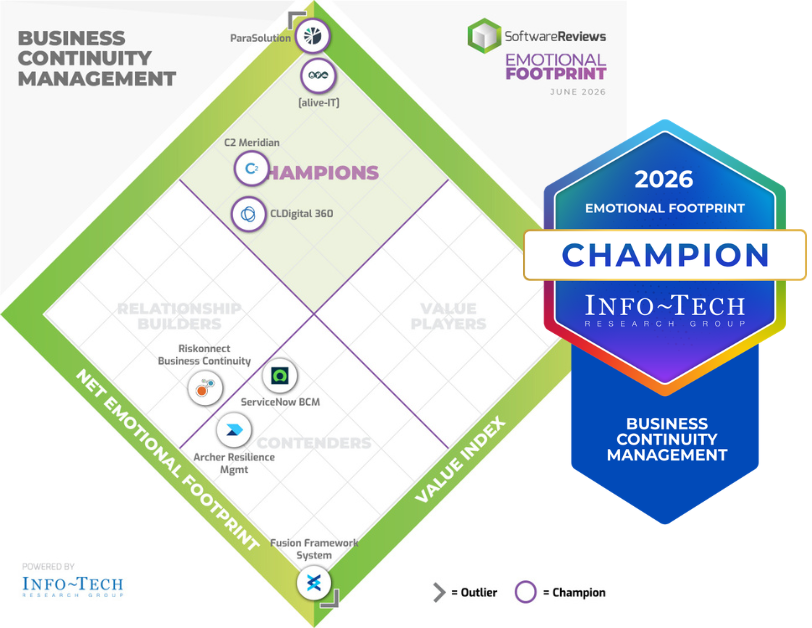
Among the 2026 BCM Emotional Footprint report, ParaSolution stood out with:
- a 9.3 Customer Experience (CX) Score;
- a +98 Net Emotional Footprint;
- 74 reviews, the highest number of verified end-user reviews in the category, out of 316 total.
While every organization's needs are different, results like these illustrate the qualities many buyers increasingly value: responsive support, product quality, and long-term customer relationships.
Among the other popular business continuity software reviews platforms include Gartner Peer Insights, and G2. Analyst firms such as Info-Tech Research Group and Gartner can also support buyers as they scope the BCM software market, compare vendor options, and translate user feedback, market research, and business requirements into a more structured selection process.
The Key When Evaluating BCM Software: Looking Beyond Features
The business continuity software market continues to evolve alongside the resilience profession itself.
For resilience practitioners evaluating solutions in 2026, independent customer feedback offers valuable context that can help inform a more confident purchasing decision.
Whether you aim for a specialized business continuity platform or broader technologies, verified user reviews suggest that organizations increasingly prioritize partnership, data integration, executive usability, and long-term value over feature quantity alone.
Marion Escriu is a Product Manager and Senior Consultant in Organizational Resilience at Premier Continuum. An ISO 22301 Lead Auditor, she oversees the strategic evolution of ParaSolution while supporting organizations in optimizing and managing their continuity programs. Premier Continuum is the developer of ParaSolution, an award-winning business continuity management software solution.
More on
About the author

Marion Escriu
Business Continuity Consultant, Premier Continuum
Marion Escriu is a Product Manager and Senior Consultant in Organizational Resilience at Premier Continuum. An ISO 22301 Lead Auditor, she oversees the strategic evolution of ParaSolution while supporting organizations in optimizing and managing their continuity programs. Premier Continuum is the developer of ParaSolution, an award-winning business continuity management software solution.