
How AI Threat Monitoring Supports Business Continuity
Every day, business continuity professionals are expected to answer a simple question:
Could this event affect our organization? The answer isn't always obvious.
A cyberattack targeting a software provider, a hurricane approaching a supplier, a transportation strike or a power outage can all become business continuity issues. At the same time, hundreds of other alerts may have little or no operational impact.
But finding information is no longer the challenge; identifying the right signals before they become disruptions is.
AI threat monitoring helps business continuity teams do exactly that by continuously analyzing trusted information sources, identifying emerging threats and supporting faster, more informed decisions.
Learn how business continuity professionals can leverage AI threat monitoring in this article by Marion Escriu, ISO 22301 Lead Auditor.
What is AI threat monitoring?
AI threat monitoring uses artificial intelligence (AI) to continuously collect, analyze and interpret information about events that could affect an organization's ability to operate.
Unlike traditional monitoring, which often relies on manually reviewing news articles or predefined alert rules, AI can process thousands of trusted information sources simultaneously, identify patterns, group related reports and highlight events that may require attention.
AI threat monitoring goes beyond cybersecurity monitoring
For business continuity teams, the value isn't the technology itself.
The value lies in transforming scattered information into meaningful operational intelligence that supports preparation, response and decision-making.
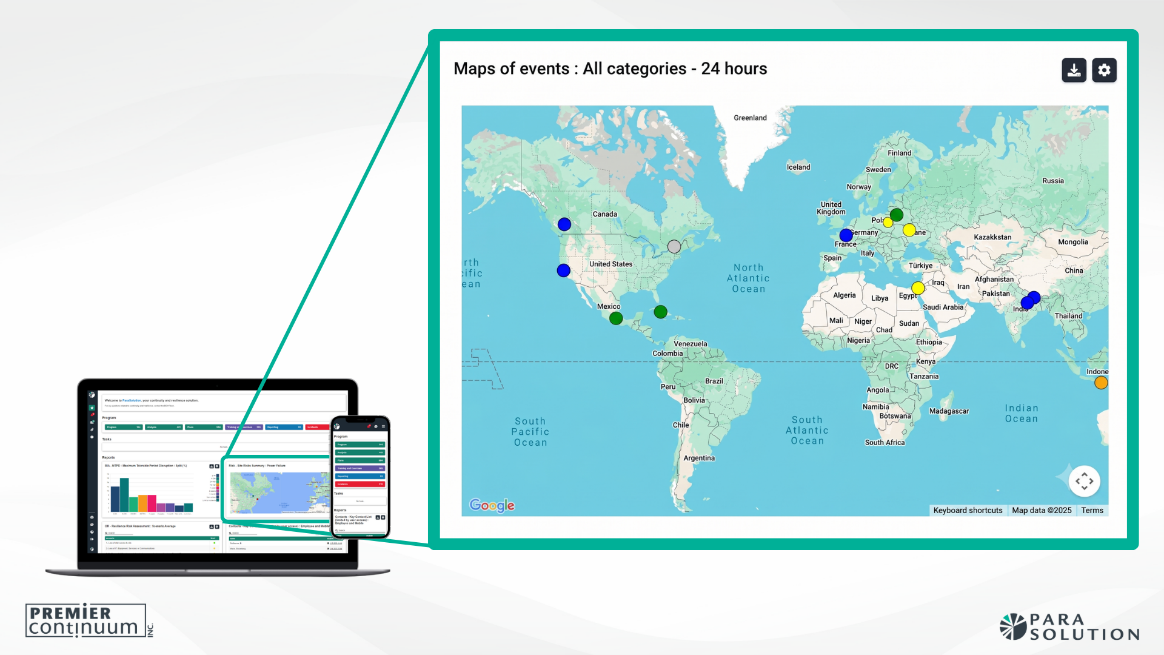
While cyber threats remain an important concern, business continuity teams also monitor severe weather, transportation disruptions, infrastructure failures, geopolitical instability, public health events, labour disputes and supply chain incidents—any event that could affect critical operations.
Why AI threat monitoring matters for business continuity
Business continuity has always depended on situational awareness.
The earlier an organization understands that an external event could affect its operations, the more options it has to respond effectively. It may decide to activate additional monitoring, contact a supplier, prepare alternate work arrangements, review recovery procedures or simply continue observing the situation as new information becomes available.
The difficulty is that today's threat landscape evolves much faster than traditional monitoring methods were designed to handle.
A single earthquake can generate hundreds of news articles within minutes. A cyber incident may trigger advisories from government agencies and many other media at the same time. A transportation strike can quickly expand into broader supply chain disruptions.
Reviewing this information manually takes time—often when time matters most.
Artificial intelligence helps reduce this burden by continuously monitoring trusted sources, consolidating duplicate information and bringing operationally relevant events to the surface more quickly.
Here are practical examples of how business continuity teams can benefit from AI threat monitoring.
How AI Threat Monitoring Supports Business Continuity Teams
Continuous monitoring of emerging threats
Emerging threats don't wait for business hours.
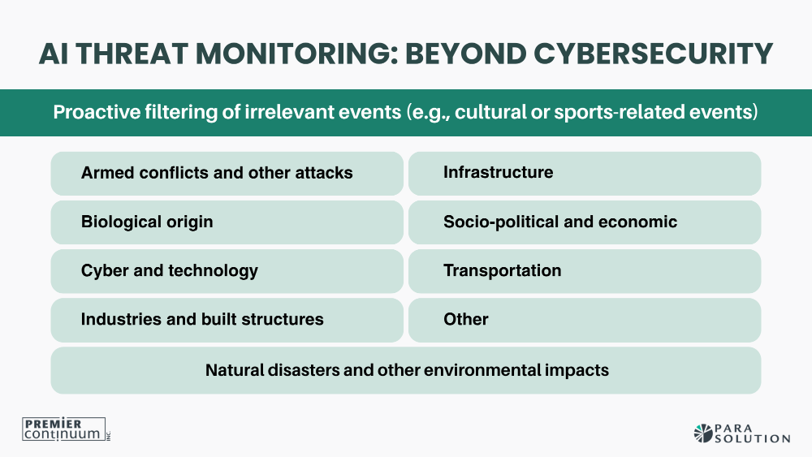
AI can continuously monitor trusted news organizations, government alerts, weather agencies, cybersecurity advisories and other external sources around the world, helping business continuity teams maintain awareness across multiple regions and time zones.
Instead of discovering an event hours later through internal discussions or social media, organizations gain earlier visibility into situations that may require further assessment.
For example, while conducting an enterprise risk assessment, an organizational resilience coordinator identified cyberattacks as one of the organization’s known risks. Threat monitoring, however, revealed a recent increase in attacks targeting organizations in the same industry. Based on this emerging trend, the coordinator reassessed the risk and determined that its likelihood had increased.
Reducing information overload
One event can generate dozens (or even hundreds) of articles, many describing exactly the same situation.
Before taking any action, business continuity professionals must determine which sources are credible, whether the event affects their organization, what has changed since the first reports and whether the situation warrants escalation. Much of this work involves processing information rather than making decisions.
AI helps consolidate duplicate reports, identify meaningful updates and separate operationally relevant events from general news.
The objective is not to generate more alerts. It is to reduce the time spent processing information so teams can focus on assessing business impacts and making informed decisions.
Identifying potential operational impact
AI threat monitoring isn't only about answering "Could this event affect us today?" It can also help business continuity teams understand which risks may become more relevant tomorrow.
By tracking patterns across industries and geographic regions, organizations can identify emerging trends such as:
- Increasing cyber activity affecting their industry
- Recurring infrastructure or transportation disruptions in critical regions
- Growing geopolitical instability near operations or supply routes
- Emerging labour disputes or extreme weather affecting key suppliers
Together, these signals provide a more dynamic risk horizon—an evolving view of the threats becoming more relevant to an organization's operations. This can complement broader exercises such as the BCI Horizon Scan with intelligence specific to the organization's own footprint.
This forward-looking intelligence can also strengthen business continuity and operational resilience exercises by helping teams develop plausible scenarios based on threats emerging in their sectors and regions.
Supporting prioritization
Imagine three events occur on the same morning: a ransomware attack affecting a software vendor, a severe storm approaching one of your facilities and a labour strike disrupting transportation in another region.
Business continuity teams rarely have the time or resources to investigate every event with the same level of urgency.
AI can help prioritize incidents based on their potential operational impact, allowing teams to focus first on the situations most likely to affect critical business activities while continuing to monitor lower-priority events.
Time savings for analysts and decision-makers
One of the greatest benefits of AI threat monitoring isn't simply detecting threats—it's reducing the time required to understand them.
In many organizations, monitoring and analyzing external threats is a resource-intensive process that can involve teams of analysts working full time to collect information, validate sources, consolidate duplicate reports and produce actionable intelligence.
By automating the collection, consolidation and initial analysis of external information, AI allows analysts to spend less time processing data and more time assessing business impacts. Decision-makers benefit from faster access to structured, contextualized information, helping them determine whether an event should continue to be monitored, escalated or acted upon.
AI supports expertise (and doesn't replace it)
Artificial intelligence is exceptionally good at processing large volumes of information.
Business continuity professionals are exceptionally good at understanding organizational context.
The two are complementary.
Over nearly three decades, Premier Continuum has helped thousands of organizations across the public sector, financial services, healthcare, transportation, manufacturing and other critical industries strengthen their business continuity programs.
One observation has remained remarkably consistent: professionals rarely lack information—they lack the time to continuously collect, validate and interpret it.
That's why AI should support expertise rather than replace it.
While artificial intelligence can rapidly identify patterns and perform an initial analysis, experienced business continuity professionals remain essential to validate findings, assess organizational dependencies and determine the most appropriate course of action.
This same philosophy guided the development of ParaSolution's Automated Threat Monitoring and Analysis Module, which combines artificial intelligence with established business continuity practices to transform external information into actionable intelligence.
The initiative began in January 2024 and brought together experts from Premier Continuum , Mila, UQAM, the Égide consortium and Luqia (newly a merger between CRIM and INO). The collaboration received the Collaboration in Resilience Award at the 2025 BCI Americas Awards.
Key takeaways when leveraging AI Threat Monitoring
AI threat monitoring can strengthen business continuity, but its value depends on how organizations use the intelligence it provides. The goal isn't to monitor more threats or generate more alerts. It is to identify what matters earlier and turn that information into better decisions.
To get the most value from AI threat monitoring, business continuity teams should:
- Focus on relevance, not volume. More information doesn't necessarily create better situational awareness. Threat intelligence should help teams identify events that could affect critical activities, locations, suppliers, technology and people.
- Connect external threats to operational context. An event becomes meaningful when it is assessed against the organization's geographic footprint, dependencies, critical resources and business priorities.
- Look beyond individual incidents. Monitoring patterns across industries and geographic regions can reveal emerging risks and blind spots that may not be apparent when events are assessed in isolation.
- Use AI to accelerate analysis, not replace judgment. AI can collect, consolidate, categorize and analyze information at scale, while business continuity professionals provide the organizational context and judgment required to determine what action is appropriate.
- Turn threat intelligence into preparedness. Emerging trends can inform risk assessments, plausible exercise scenarios and continuity strategies, not only incident response.
- Keep reassessing as situations evolve. Threats are rarely static. Continuous monitoring helps teams understand what has changed and whether those changes should affect their assessment or response.
Ultimately, effective AI threat monitoring isn't about reacting to every event. It is about recognizing the right signals early enough to assess, prepare and act.
As the volume and speed of external information continue to grow, this combination of continuous intelligence and human expertise can help business continuity teams move from simply monitoring disruptions to anticipating how emerging threats could affect their organization.
Interested in seeing how AI Threat Monitoring works in practice?
Learn how ParaSolution's Automated Threat Monitoring and Analysis Module detects, analyzes and prioritizes emerging threats.

Request a completely free demo or contact a sales representative to discuss it further!
More on