
Resilience Starts at the Top: Why Every Business Needs a Continuity System
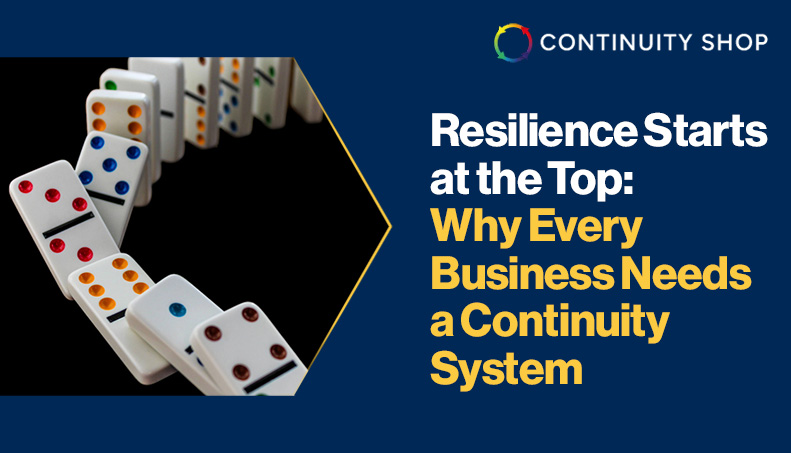
Every business, whatever its size, will eventually face a day when something goes wrong: a fire, a flood, a cyber-attack, the sudden loss of a key supplier, or simply the illness of the one person who “keeps everything running.” The businesses that survive these moments aren't the lucky ones — they're the ones who decided, in advance, that resilience was worth building into how they operate.
That's the starting point of business continuity: not a folder of paperwork, but a system. The BCI's Good Practice Guidelines, the internationally recognised framework for the profession, call this a Business Continuity Management System (BCMS) — and it's the first of six professional practices that make up good continuity management.
Establishing a BCMS begins with leadership. It's a deliberate choice by owners and directors to say: we will identify what matters most to this business, we will understand what could disrupt it, and we will put sensible, proportionate arrangements in place to keep going — or get going again quickly — if the worst happens. That commitment needs a policy, a named owner, and enough time and budget to make it real, rather than a line in a health and safety manual nobody reads.
For a Greater Manchester SME, this doesn't need to mean hiring a continuity department. It means agreeing what “good” looks like for your business: What's the maximum time you could survive without your website? Without your main supplier? Without your premises? Setting those boundaries, and reviewing them once a year, gives every other continuity activity — risk analysis, planning, testing — a clear purpose and a clear owner.
It also means being honest about scope. A BCMS should cover the activities that generate your revenue, protect your reputation, and meet your legal and contractual obligations — not every conceivable inconvenience. Trying to plan for everything is how continuity programmes stall before they start. Trying to plan for the things that would genuinely put you out of business is how they succeed.
There's a commercial upside too. Increasingly, larger organisations — councils, NHS trusts, corporate clients — ask their suppliers to demonstrate continuity arrangements as part of procurement. Chamber members who can point to a functioning BCMS, even a simple one, have a genuine edge when bidding for contracts that require assurance of supply.
The good news is that establishing a BCMS is the easiest of the six practices to start this month. It requires a decision, not a budget: pick an owner, write a one-page policy, and set a date to review it. Everything that follows in this series — understanding your risks, designing solutions, and testing them — builds on that foundation.
Continuity Shop delivers the BCI's Certificate of the Business Continuity Institute (CBCI) training and provides business continuity consulting to organisations across Greater Manchester and beyond. If this article has raised questions about where your own business stands, get in touch with Continuity Shop [email protected] to talk through your options.
More on