
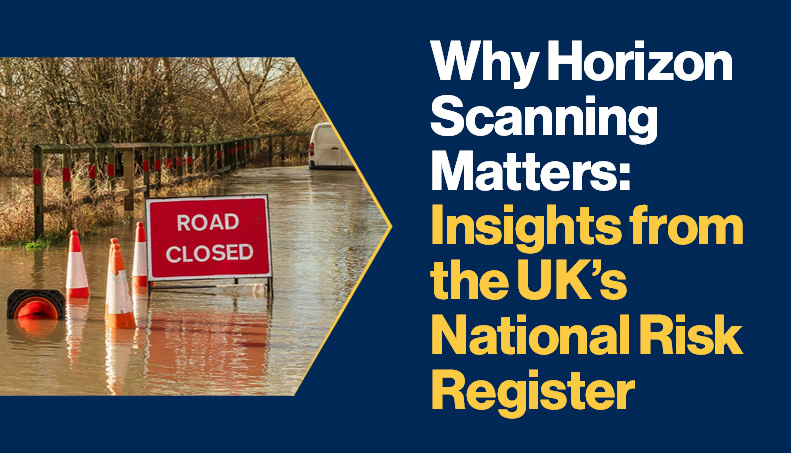
Why Horizon Scanning Matters: Insights from the UK’s National Risk Register
On July 14, 2026, the UK government updated its National Risk Register, assessing the most serious risks to the UK, its people, infrastructure, economy, and national security.[1]
The update identifies water infrastructure failure or loss of drinking water and a pandemic as the most severe risks currently facing the UK, with both assessed as having a potentially catastrophic impact and a high likelihood of occurring. Terrorist attacks in publicly accessible locations also remain a significant concern. In addition, it introduces several new risks, including digital resilience failure, risks to data infrastructure, cyber-attacks on water and police systems, and damage to the gas transmission network.
Many countries publish a formal National Risk Register or conduct national risk assessments to identify and evaluate major threats and hazards. Publicly available risk registers are useful for horizon scanning, as they provide a trusted overview of the most significant risks facing a country, helping organisations to prioritise planning and align their resilience activities with national risk priorities.
The importance of horizon scanning
Effective resilience programmes require continuous horizon scanning to identify emerging threats, trends, and vulnerabilities before they materialise into disruptive events. Horizon scanning involves systematically monitoring developments across political, economic, social, technological, environmental and security domains.
Maintaining access to timely and accurate information is critical to effective horizon scanning. Resilience professionals should ensure that information sources are verified to identify and counter false or misleading information, a growing challenge for organisations as advances in artificial intelligence and digital platforms are increasing the speed, scale, and sophistication of false or misleading content.[2]
Horizon scanning techniques for resilience practitioners
BCI research indicates that the most common method of horizon scanning is internal risk and threat assessment, followed closely by external reports and industry insights.[3]
However, only just over 40% of organisations use country or industry risk registers as part of their approach. By not incorporating risk registers into horizon-scanning activities, resilience practitioners may overlook emerging threats and trends, potentially leaving their organizations less prepared for disruptions that have been identified at national level.
Organizations should consider whether their risk assessments reflect the latest national threat landscape.
BCI research[4] shows that the most concerning challenges for practitioners over the next 5-10 years are cyber security, climate risks, and the role of AI, but pandemic planning, highlighted as a top threat to the UK, has all but dropped off practitioners’ radar with only 3.4% of respondents identifying pandemic/non-occupational disease as a top concern.
This highlights a contrast between organizational risk priorities and nationally identified threats. Such a gap can lead to preparedness blind spots, where organizations underestimate risks and may not develop appropriate mitigation, response, and recovery plans.
As well as monitoring national risk registers, practitioners could review daily news, government publications, industry intelligence such as the BCI’s annual Horizon Scan Report, regulatory developments, and lessons identified from significant global incidents. By incorporating a wide variety of verified intelligence, organizations can be better prepared against emerging threats and benchmark their own risk assessments against broader industry trends.
Strengthening preparedness through risk awareness
The UK’s updated National Risk Register provides a valuable opportunity to review existing assumptions and preparedness arrangements. It identifies 95 risk areas, an increase from 2025’s 89 risks, indicating the importance of regular horizon scanning and risk assessment to keep pace with emerging threats.
While not all will directly affect every organization, understanding these broader national risks can help organizations strengthen preparedness by making more informed resilience decisions.
More on
About the author

Rebecca Mathews
Content Manager, The BCI