
It's Everyone's Job: Embedding Continuity Across Your Team
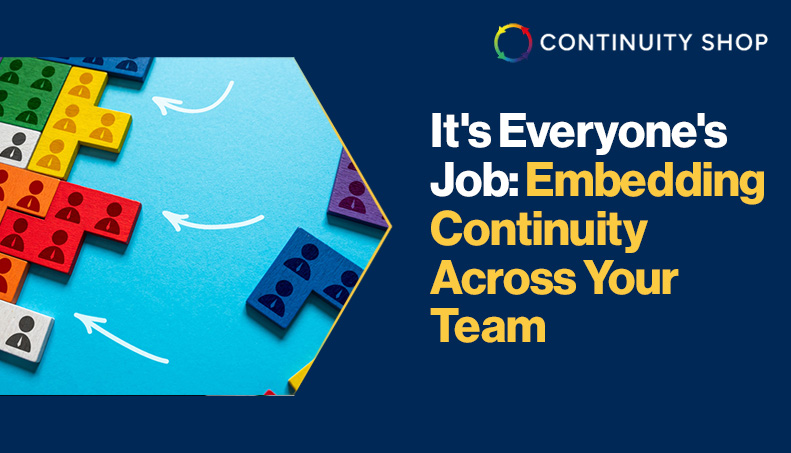
A continuity plan that lives only in the owner's head, or in a single document nobody else has read, isn't a plan — it's a single point of failure of its own. The second professional practice in the BCI's Good Practice Guidelines, Embracing Business Continuity, addresses exactly this: how you get continuity thinking out of one person's inbox and into the everyday culture of the business.
This matters because disruptions rarely announce themselves conveniently. The person who knows where the backup generator switch is, or which supplier has a second factory, might be on holiday, in hospital, or simply not answering their phone when disaster strikes. Embedding continuity means enough people understand enough of the plan that the business doesn't depend on one hero showing up.
Practically, embedding starts with awareness, not training courses. Make sure staff know a continuity plan exists, roughly what it covers, and — critically — what their own role would be if it were triggered. A five-minute slot in a team meeting, twice a year, does more good than an annual all-staff briefing nobody remembers by lunchtime.
Communication is the second pillar. Who tells staff not to come in if the building's flooded? Who talks to customers if a system goes down? Who speaks to the press if something goes badly wrong? These are decisions worth making calmly in advance, not worked out for the first time while it's actually happening.
Embedding also means building continuity thinking into ordinary business decisions — not as a separate exercise, but as a habit. When you take on a new supplier, ask what happens if they fail. When you move to new software, ask how you'd cope without it for a day. When you hire, ask whether a single person now holds knowledge nobody else has. None of this requires a formal review process; it requires the question becoming a normal part of how decisions get made.
For chamber members running lean teams, this is where continuity earns its keep without costing much. A well-embedded culture of “what if” thinking costs almost nothing and catches problems long before they need a formal plan to fix them. It also tends to surface naturally in conversations with staff closest to day-to-day risk — the person on the shop floor, the driver, the account manager — who often knows where the fragile points are long before senior management does.
The aim isn't to turn every employee into a continuity professional. It's to make sure that when something goes wrong, more than one person in the building knows what to do next — and that the plan reflects how the business actually runs, not just how it looks on paper.
Continuity Shop delivers the BCI's Certificate of the Business Continuity Institute (CBCI) training and provides business continuity consulting to organizations across Greater Manchester and beyond. If this article has raised questions about where your own business stands, get in touch with [email protected] to talk through your options.
More on