
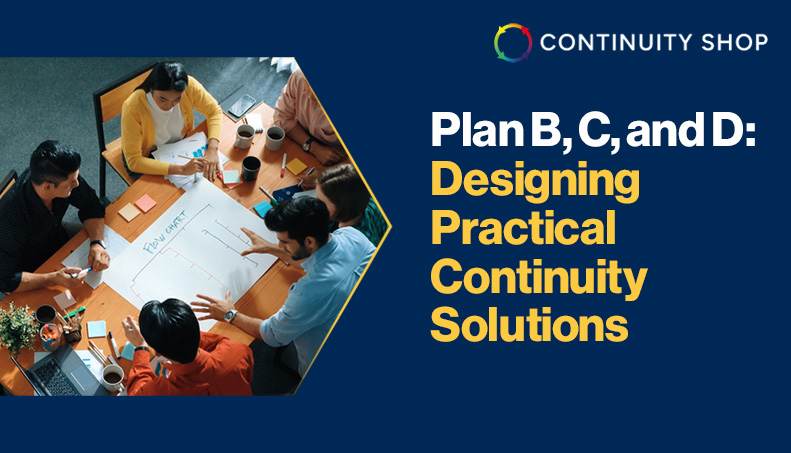
Plan B, C, and D: Designing Practical Continuity Solutions
Once you know what matters most and what threatens it, the next professional practice — Solutions Design — is where you decide how you'd actually keep going. This is the part people usually picture when they think of “business continuity”: the alternative premises, the backup systems, the emergency contact list. But good solutions design starts with a more useful question than “what's our Plan B?” It starts with “what's the cheapest, simplest way to meet the recovery time we identified in our analysis?”
That distinction matters because solutions cost money, and not every risk justifies an expensive fix. If your analysis showed you could tolerate three days without your main premises, you don't necessarily need a contracted disaster recovery site sitting empty and ready — you might just need laptops, a cloud-based system, and a plan for staff to work from home or a borrowed office for a few days. Match the solution to the actual tolerance, not to worst-case anxiety.
Common, proportionate solutions for Greater Manchester SMEs include: diversifying suppliers so no single failure stops production; ensuring data and systems are properly backed up and, crucially, that restoring from backup has actually been tried; agreeing informal reciprocal arrangements with a similar local business for premises or equipment; cross-training staff so critical tasks aren't held by one irreplaceable person; and keeping an up-to-date, accessible contact list for staff, suppliers, and customers that doesn't live solely on the server you're trying to recover.
Cost-conscious businesses should also consider what not doing anything would look like, and treat that as a legitimate option for lower-priority risks — provided it's a conscious decision, documented and reviewed, rather than an oversight. Continuity planning is about proportionate risk management, not eliminating every possible disruption regardless of cost.
It's worth designing solutions collaboratively with the people who'll use them. A working-from-home plan designed by management without asking whether staff actually have suitable broadband, equipment, or childcare cover during a crisis is a plan that will fail exactly when it's needed. The same applies to supplier alternatives — have you actually spoken to that back-up supplier, or just assumed they'd help?
Solutions design also naturally surfaces gaps that analysis alone doesn't show — for instance, discovering that your only alternative supplier is on the same industrial estate, exposed to the same flood risk, or that “working from home” assumes internet connectivity your business premises don't actually have as a fallback.
The output of this stage should be a short, practical set of agreed strategies for each critical activity — not a lengthy document, but a clear answer to “if this happens, here's roughly what we'd do.” The next practice, Enabling Solutions, is where those strategies get turned into something you could actually execute under pressure.
Continuity Shop delivers the BCI's Certificate of the Business Continuity Institute (CBCI) training and provides business continuity consulting to organizations across Greater Manchester and beyond. If this article has raised questions about where your own business stands, get in touch with [email protected] to talk through your options.
More on