
Building Resilient Communications: Leadership, Training and Technology Lead the Way in 2026
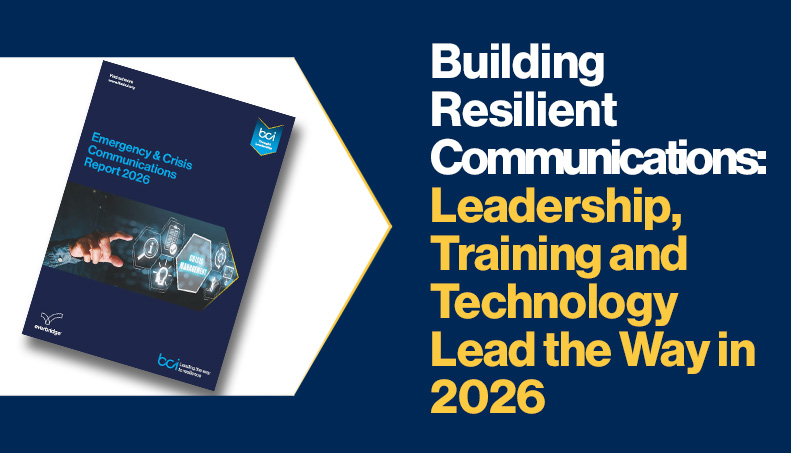
The Business Continuity Institute (BCI), in association with Everbridge, has released its Emergency Communications Report 2026, focusing on how organizations’ structure, lead and support emergency and crisis communications in today’s risk environment. The report reveals a strong role for senior leadership, and widespread use of formal plans, alongside ongoing challenges related to human behaviour.
Senior leadership and formal plans
Most organizations rely on senior leadership to take the lead in emergency communications, with top management responsible for addressing both internal and external stakeholders during times of uncertainty.
The report shows that most organizations formalise emergency communications through structured plans and have a rapid deployment ability. Nearly 90% of organizations have a formal emergency communications plan, and over three quarters of them can activate it within 30 minutes, crucial in the early stages of a situation when information is limited and scrutiny is high.
Coordination and training
Clearly structured methods extend to coordinating crisis management teams and engaging the wider workforce. Most organizations prefer widely used tools like email, enterprise messenger apps and texting to activate and coordinate their crisis teams, giving the benefits of speed, familiarity and collaboration.
Training and exercises are also central to making these arrangements work in real events. Most organizations run structured programmes at least annually, involving staff at all levels of responsibility. This helps ensure that plans and tools can be translated into effective action.
This emphasis on rehearsal and capability-building is reflected in the outcomes reported: over 70% of those organizations report that they have either often or always achieved their expected response levels over the past twelve months.
However, the report indicates that there are still gaps to be addressed that can undermine otherwise strong arrangements, including lack of response from staff or recipients (60.7%), inaccurate staff contact information (42.2%), and switched off devices (39.9%)
During 2025 preparedness has been tested frequently, with 72.4% of organizations reportedly activating their emergency communications plan in the past twelve months. The top three triggers were adverse weather, IT or telecoms outage, and cyber security incidents.
The regulatory landscape
As in many other areas, trends in emergency communications are being shaped by regulatory developments. Organizations are now paying closer attention to formal standards and expectations, demonstrated by the fact that the report shows nearly half (48.9%) of organizations have adapted their emergency communications and crisis management practices in response to new regulatory requirements.
Maria Florencia Lombardero Garcia, Thought Leadership Manager at the BCI, comments: ‘Regulation is becoming a significant driver of investment in stronger governance, clearer plans and more robust communication capabilities. This regulatory momentum is helping to embed more consistent good practice across industries, reinforcing the strategic importance of emergency communications to organizational resilience. The report shows that getting the support of senior leadership, formal plans in place, and regular training and exercising programmes is crucial for effective emergency response.’
“This year’s report reinforces a clear reality: effective emergency communication is a core leadership responsibility,” said Steven Fanale, Chief Revenue Officer at Everbridge. “Organizations are making progress in formalizing plans and improving activation speed. But performance still depends on engagement, accurate information, and regular testing and training, even as teams explore technologies such as AI to support faster decision-making. The ability to demonstrate true readiness will define resilient organizations and provide a meaningful competitive advantage.”
The BCI Emergency & Crisis Communications Report 2026 is available to download now for BCI Members. An Executive Summary of the report is available to download now for non-members.
Download the report
More on