
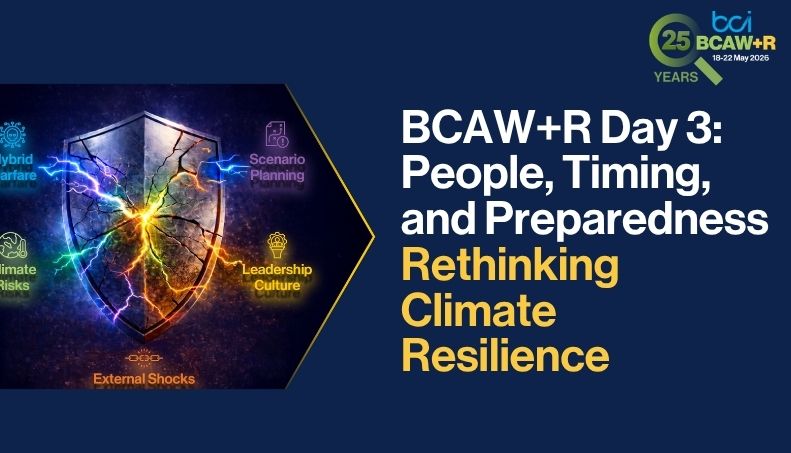
BCAW+R Day 3: People, Timing, and Preparedness - Rethinking Climate Resilience
At the midpoint of BCAW+R, six insightful webinars brought climate risk and resilience into focus.
Today’s speakers shared practical, integrated approaches shaped by real-world experience, exploring how organisations are adapting their resilience strategies to meet the growing challenges of climate-driven disruption.
The day started with the all-important role of people. Discussions highlighted that while frameworks and metrics remain critical, services ultimately depend on a workforce. In the first webinar, Dr Olivier Lo examined climate risk direct impacts on workers, as well as risks linked to adaptation and mitigation activities. He emphasised the importance of vulnerability-aware assessments, enabling organisations to identify which roles, locations, and shifts are most exposed, while also recognising cascading risks, such as flooding leading to illness and workforce absence.
A thought-provoking webinar from Peter Duffy followed, who used software to translate climate risk into structured insights, highlighting the growing importance of dashboards, reporting tools, and governance frameworks in turning environmental volatility into measurable actions.
Kicking off the first of two afternoon sessions was Patricia Pampolin, who explored the concept of temporal criticality and introduced Critical Time Periods (CTP) and Critical Time Objectives (CTO) to capture how tolerance for disruption fluctuates during peak operational windows. Patricia was followed by Paul Cutler and Andrew Morkot, who examined how risk, resilience, and business continuity teams can break down silos, a perennial problem identified by BCI research, to better anticipate, assess, and respond to climate-driven events.
Modebola Ajibodu took us through the afternoon with an insightful presentation and a “think outside the box” challenge. This session challenged practitioners to look beyond their existing models to identify overlooked vulnerabilities. Unconventional scenarios, cascading effects, and “black swan” climate events were discussed, along with ways to anticipate them.
Day three of BCAW+R concluded with a presentation from Diogo Silva Viana, who explored practical approaches to preparing for climate-driven crises. Diogo focused on preparation and guided participants through activities such as identifying early triggers that signal the need to activate climate crisis preparedness measures, and pre-approving key actions to enable faster decision-making during an incident.
Today’s insightful sessions reinforced a consistent message: climate risk acts as a multiplier of existing vulnerabilities. Building resilience therefore requires not just better data or frameworks, but more integrated, practical, and people-focused strategies that ensure organisations can adapt and continue operating when disruption occurs.
If you missed any of today’s insightful sessions, you can catch up here.
Join us tomorrow for the fourth day of BCAW+R, which will focus on external shocks. Learn about threat intelligence, risk registers, equipping the next generation, and much more.
Don’t forget to download your free toolkit, posters, and new BCI white paper here.
More on
About the author

Rebecca Mathews
Content Manager, The BCI