
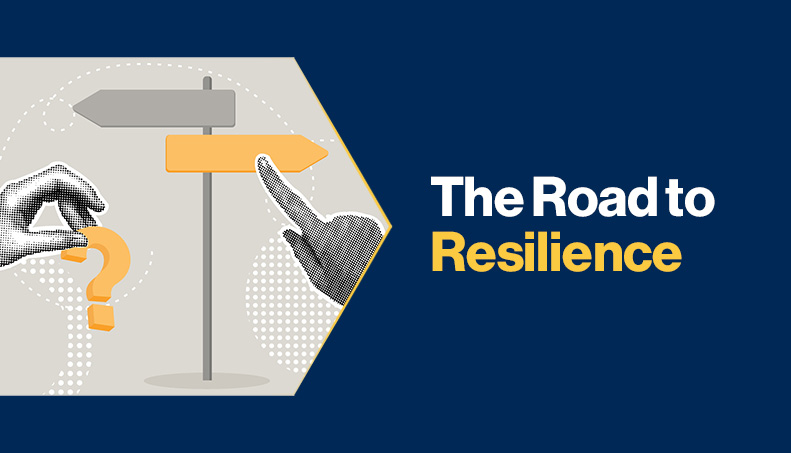
The Road to Resilience
In writing this series I am bringing together previous thoughts on supply chain and the series on business impact analysis[1], with the aim of culminating in better planning. That means the plans themselves, for now at least, can take a back seat in the debate.
A question I often ask is, what is resilience? Can you answer that without using the words absorb, shock, adapt, bounce back, thrive, survive, and bouncing forward?
I used to buy engineering products in my time as a procurement professional, and some products were specifically using the word resilient, to distinguish themselves from less resilient products.
The key attributes of these items were their ability to resist pressure. Parts of the products would flex under pressure (absorbing the pressure and adapting to the pressure) then return to their original state (bouncing back). It was a fixed underground asset, it could not return to a better state than it started, but that resiliency endured making it durable and giving it longevity.
These were vital components of a larger network and system, so a potential single point of failure meant that the system itself had to be both durable, adaptable, and resilient.
So, this is my take on resilience as a durable, adaptable system and network, which I believe is how operations, or indeed an organisation, should be created.
Specification
Prior to procuring such engineering, we needed to create a performance specification, how long would the asset resist pressure, what could be the cause of such spikes, how long must it resist, flex and return to its minimum operable state, and what are the consequence and standard operating procedures to deal with a partial or complete failure.
This may be an insight into how and why I see resilience, risk and business continuity management, the way I do.
In following stated good practice, I am creating that performance specification, in analysis I am discovering the main operating requirements of that performance specification, then I create the specifications based on the analysis.
In creating a solution specification, I am also considering the cost and the benefits delivered by that performance specification and choosing if such resilience is worth investing in. Sometimes engineers would favour less resiliency and be prepared to “fix on failure” literally replacing the asset. To me that sounds like the Good Practice Guidelines[2] in action.
Creating the roadmap
In the past we used to say that undertaking business continuity management (BCM) may be the first time you really map the organisation, through the business impact analysis (BIA) process. Later we spoke of critical path analysis, and today we talk of mapping the supply chain and of value chain mapping.
However you see it, you are understanding your organisation like a city map, overground and underground, as a road and rail network may look.
The questions to ask
To use this analogy further; what is the capacity of each road or track, the speed limits, how much of the network can collapse or be temporarily blocked, how do we operate efficient diversions, do alternatives have the additional extra capacity?
What are the risks involved, how long will we tolerate closures and diversions, are there cliff edges and no-go areas, dead ends?
Will I have satellite navigation to guide me through traffic offering alternative, safe routes designed for extra capacity to keep me on the road to my destination within my desired timescales. A mimic board display for trains?
Where is that knowledge, that competency and capability held, like a London taxi driver learning “The Knowledge” practiced routes? The knowledge has to exist in a system or document, before it can be practised and absorbed to make it instinctive. Take a taxi in New York, Istanbul or London and they may use satellite navigation, but they have learned alternative routes that lead to the same destination in a timescale that works for the customer.
Here I hope I have set the stage to discuss how this road to resilience can be achieved using the BCI Good Practice guidelines and its technical practices. Part two will look at reading the ‘map’.
More on
About the author

David Window
Director, Continuity Shop