
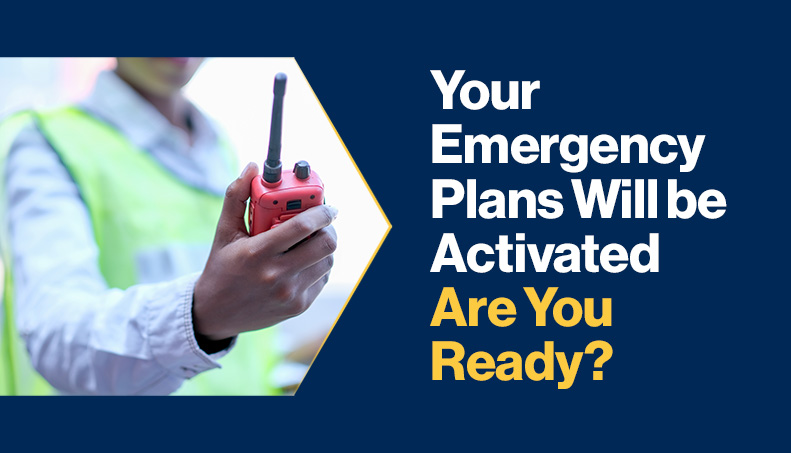
Your Emergency Plans Will be Activated – Are You Ready?
The frequency with which organizations are activating their emergency communications arrangements is increasing. Today’s risk landscape is so broad that organizations should now expect challenges, and they will need to communicate effectively both externally and internally when crises occur. This is no longer an ‘if’ scenario, but ‘when’, making agnostic planning essential.
Research[1] shows that over 70% of organizations had to activate their emergency communications plan in the past twelve months.
Triggers for plans
The same research shows the top three triggers of emergency communications, and this makes for sobering reading: adverse weather (54.8%); IT or telecoms outages (44%), and cyber security incidents (35.7%).
A snapshot of recent events backs this up. For example, in January this year Indiana’s winter storm provoked a statewide disaster declaration from Governor Mike Braun[2]. Last year wildfires and severe weather in South Carolina triggered a State of Emergency from Governor Henry McMaster[3], and the state also deployed its Urban Search and Rescue team to assist with severe flooding response in Texas.
In the digital domain healthcare has been hard-hit. In 2025 there were three major cyber-security incidents. In Massachusetts a hospital confirmed a cybersecurity incident that affected its internet, email and phone lines[4]. This led to incident response protocols being activated and the emergency department was even closed to ambulances, which were diverted to other facilities.
Ambulances were also affected in a ransomware attack on Frederick Health, which immediately activated its incident response protocols and took steps to secure its systems[5]. This was a major attack, exposing the sensitive data of nearly one million patients, and also triggering law enforcement involvement and mandatory federal breach reporting.
Training and exercising are key
The main pillars of preparedness are staff training, and the regular exercising of continuity plans. Indeed, this is an area that is improving year-on-year. Research shows that over 80% of organizations conduct training at least once a year[6] and a similar number exercise their plans at least once a year.
Training has seen a steady rise over recent years. According to research, in 2019[7] only 52% of organizations carried out regularly scheduled training programmes for emergency communications plans, rising to 75% in 2025[8]. This year’s exact figure is 81.3%. This demonstrates that organizations are better prepared, and as that training awareness increases it also highlights the importance of the human factor in preparedness.
That background work makes crisis communication effective. Top management’s involvement is also vital - and consistent with ISO standards on crisis management and business continuity[9], which stress the importance of senior leadership in overseeing external communications during incidents.
A strong disaster safety culture and reliable emergency communications depend as much on people, data quality, and message clarity as on systems. Regular testing and exercises are essential to expose blind spots and ensure that protocols work in practice, not just on paper, when a real emergency strikes.
Access the BCI Emergency & Crisis Communications Report 2026
More on
About the author

Brian Runciman
Content Manager, The BCI