
BCAW+R Day 5: Think Your Leadership Culture Can Handle Crisis? Think Again!
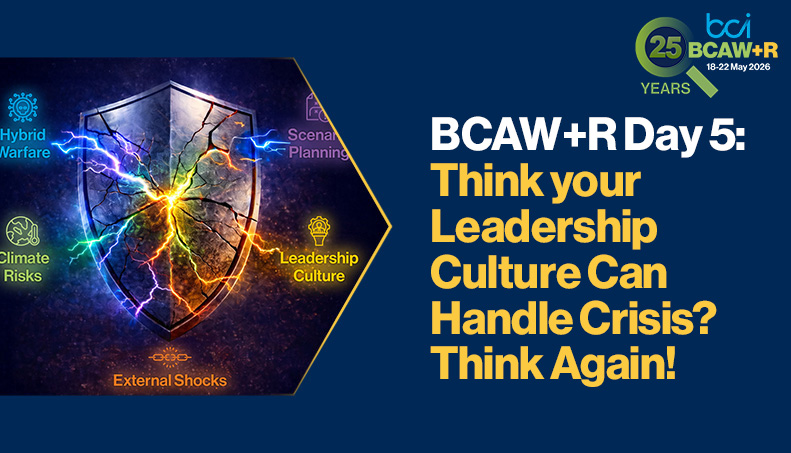
The last day of an exciting week at the BCI’s annual Business Continuity & Resilience Awareness Week (BCAW+R) concluded with the theme "Think your leadership culture can handle crisis? Think again!"
The day looked at how resilient leaders adapt, communicate clearly, and build trust under pressure. It focused on what agile, "antifragile" leadership looks like and how to build a culture that thrives in uncertainty.
Session highlights – leadership
The day started with what the UK can take from the Swedish approach and how it translates into practical action. “Total Defence Lessons from Sweden for the UK” showed how stronger cross-sector cooperation, public–private collaboration, and a society-focused resilience strategy can enhance national preparedness and organisational continuity.
“How Leaders and Teams Stay Clear, Focused, & Effective When It Matters Most” showed leaders and teams how to transform pressure from something they manage into something they can use. It also gave practical tools for staying focused, improving team alignment, and creating better results when it matters most.
Great leaders are not defined by how well they lead when times are good, but rather are forged in crisis. That was the message of “When the World Doesn’t Stop: Navigating Humanitarian Response Remotely”. The webinar provided a framework for leading geographically dispersed teams through active crisis, alongside practical strategies to control the narrative and combat misinformation in real time.
The session “Building Capabilities That Strengthen Organizational Advantage” presented a practical journey from needs assessment to benefits realization, grounded in BCI GPG and ISO 22301 principles. This webinar was aimed at practitioners, leaders, and organizations in different sectors and geographies who are seeking to build future‑ready resilience functions and move beyond compliance to meaningful, competitive capability.
At a more personal level, “Crisis Management Leadership Capabilities for High Stakes Events” showed how organizations can intentionally select, train, and prepare executive and senior-level crisis management team members who possess the traits that consistently correlate with effective crisis leadership: grit, fortitude, patience, business acumen, empathy, and grace under pressure
“Resilience Isn't a Plan. It's a Culture” made the case that resilience is not something you build into a document. It is something that lives, or doesn't, by how your leaders behave when a crisis hits, how they communicate in the hours and days that follow, and whether the people around them feel steady or adrift. The webinar gave a clear, applicable framework for assessing whether leadership culture would hold under real conditions, and what to do if the honest answer is no.
The final webinar of the day “How Intelligent Intuition Shaped Crisis Leadership at Glasgow Airport” looked at the events of 30th June 2007. A vehicle-borne improvised explosive device was driven into the terminal entrance at Glasgow Airport, yet the airport reopened to full operations in under 24 hours. The central argument was that recovery speed was determined not solely by the plans themselves, but by the intelligent intuition of the leaders executing them.
Review at your leisure
If you missed any of the week’s many practical items, or would like to revisit them, the webinar recordings are available to be viewed at Business Continuity & Resilience Awareness Week (BCAW+R) 2026 | BCI
More on
About the author