
The Year in Resilience: Tech Takes Centre-Stage
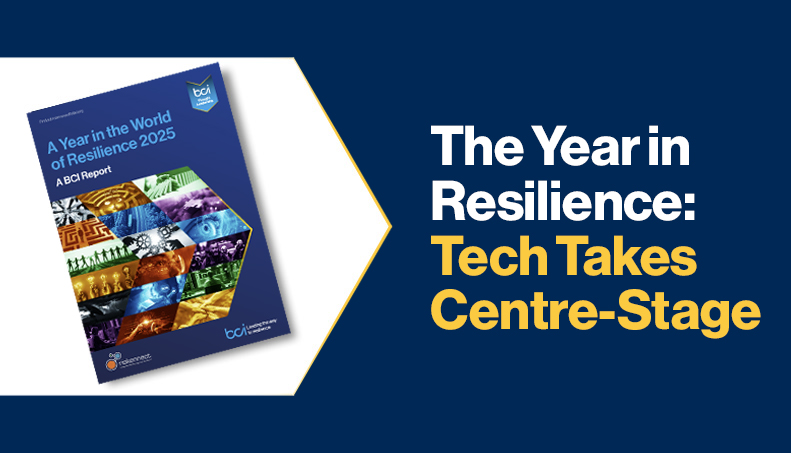
The much-anticipated third edition of The BCI’s A Year in the World of Resilience Report, sponsored by Riskonnect, has been published.
Designed as a benchmarking tool, the report enables business continuity and resilience professionals to compare organizational practices and performance globally, identify key industry developments and innovations from the past year, and anticipate emerging trends and threats shaping 2026 and beyond.
Since last year’s report there are increases in top management’s direct involvement in the implementation of artificial intelligence, projected spending on artificial intelligence, adoption of dedicated business continuity management software, and in budgets dedicated to cyber resilience.
However, top management’s direct involvement in regulations has decreased, although it remains the area that catches the most attention from senior leadership.
This years’ reports notes both internal and external turbulence in the operating environment. While the term resilience is becoming the overarching umbrella term for many organizations, supported by building blocks such as business continuity, cyber resilience and crisis management, the landscape remains somewhat fragmented. In fact, nearly 55% of organizations have now either fully or mostly integrated resilience functions, with the main obstacles to full integration being resource constraints (61.3%), siloed systems or data (54.7%) and competing priorities (51.3%).
Senior management involvement
Legislation has seen senior leadership responding with direct involvement in compliance efforts, with nearly three-quarters directly involved. Top management are also directly involved with cyber resilience (71.4%) and AI (71.2%). However, some areas lag here, such as supply chain resilience (48.7%) and pandemic planning (32%).
Artificial intelligence has risen to the top of agenda for executives. At an operational level, most professionals use it to craft scenarios for exercises and simulations, although its adoption in more analytical tasks, such as the business impact analysis, is still not a widespread practice.
The tech approach
In addition to the burgeoning AI focus, many organizations are now making the leap to using dedicated business continuity software, decreasing their use of standard business software such as Microsoft Excel for regular resilience tasks. In fact, 55.5% of professionals consider technology as very or extremely important in responding to disruptions, whilst nearly half (45.9%) of respondents consider AI an important supporting tool for their business continuity programs.
The report reveals that the top three current uses for AI in business continuity and resilience are post-incident/after-action analysis, creation of scenarios for training and exercising, and data summarisation & automated report generation.
In keep with the tech focus, the top three sources of supplier failure have a heavy tech bent, with IT and telecommunications communications being top of the list (54.9%). Next come software (50.8%) and utilities (41%).
Budgeting
Budgets for the year ahead look favourable for most resilience areas, especially, again in tech-related areas. Cybersecurity is currently the area with the largest financial resources, and it is projected to remain at the top for next year. While divisions such as business continuity, operational resilience and crisis management are not doing as well, their budgets are likely to be confirmed without reductions.
Whilst higher spending on AI is anticipated by 59.6% of responders, at 64.5% cyber resilience budgets remain the most well-resourced area in resilience, growing from last year. Business continuity and resilience budgeting is expected to remain stable. Less than ten percent of responders expect budgets to decrease in the near future.
The wider picture
The concentration of resources in the cyber domain fits in with future concerns, where state-sponsored cyber-attacks rank as the number one consequence of geopolitical dynamics for organizations (60.7%). The top three geopolitical concerns are rounded out with global economic uncertainty (55%) and regulatory changes (51.4%).
However, in keeping with senior management involvement, supply chain disruptions are slipping under the radar.
“Resilience has clearly moved onto the strategic agenda, driven by growing executive focus on areas like cyber and AI,” said John Verdi, Senior Director of Professional Services at Riskonnect. “This year’s report also reveals critical blind spots in supply chain and crisis readiness, offering organizations clear direction on where alignment and investment are most needed. We’re proud to sponsor this research with the BCI to help organizations strengthen resilience for the future.
Download the report
More on