
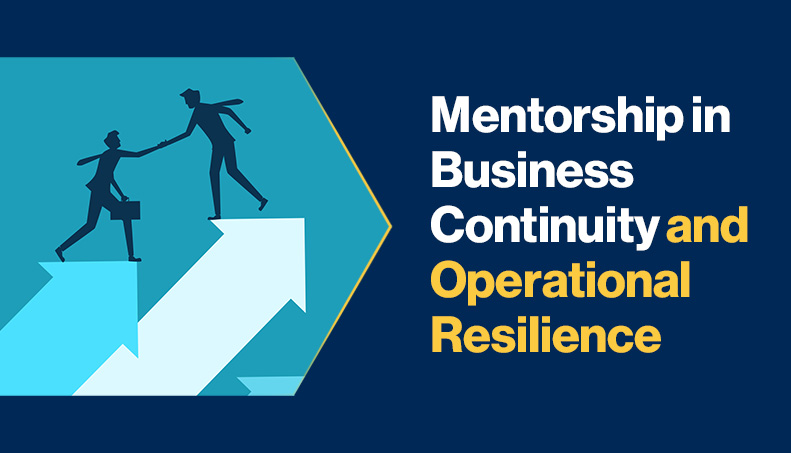
Mentorship in Business Continuity and Operational Resilience: What Mentees Should Expect—and How to Make It Count
If you want to grow your career in business continuity and resilience, I highly recommend that you consider being mentored. An internal mentor is helpful to navigate company culture, while an external mentor can assist with perspective and alternate viewpoints on the industry at large.
When approaching a mentor – mentee relationship, you shouldn’t expect the person to hand you answers. Instead, the value of the relationship is to challenge your thinking, broaden your perspective and accelerate your professional development. Think of the mentor as a guide, to challenge your existing viewpoint and provide insight into alternative ways of thinking. Ideally, it becomes a two-way street, with both of you contributing perspectives and approaches to the work.
Strategic insight over quick fixes
So, what can you expect from a mentor? Ideally, you should seek out a mentor with experience in the field. Rather than simply sharing templates or checklists, a strong mentor will explain why they make the decisions about program development and its execution. Understanding the reasons that they do certain things is worth the time investment, even if you don’t ultimately take a similar approach.
Many of us work in relative silos in our organizations and no two business continuity management (BCM) or resilience programs are the same. Although our accreditation organizations, like The Business Continuity Institute (BCI), offer best practice standards, every company puts their own spin on resilience programs. So, it is helpful to learn from your mentor what decisions were made and why specific programmatic elements are embraced.
As a mentee, this can help you to understand if a similar methodology makes sense for your organization. Additionally, building a knowledgebase about the lessons learned, internal trade-offs and why your mentor operates in the way they do can help you to determine if the same or a different approach will work best for your own company culture. A mentor’s greatest value is helping you to develop your judgement and grow your skills. The relationship is less about sharing the steps of how to do things but more about building a network to benchmarking and working with someone who will be champion for your career.
Realism, not perfection
We all know that resilience is about managing uncertainty and building the internal controls and muscle memory to needed to return to business-as-usual (BAU) as quickly as possible. Because no plan is flawless, mentors can help you to focus on what matters most: thinking about variables, the importance of managing risk and communicating effectively with leadership.
A successful resilience program incorporates BCM but really it’s becoming proficient in the soft skills of learning how to best engage your stakeholders that matter. The technical skills are important too, but easier to master. A seasoned mentor can assist you in becoming more proficient in both areas.
Learning the soft skills are what help you advance your career, and I suggest you focus your one-to-one time on that, once you discuss the technical aspects of resilience programming.
Constructive challenge
When engaging a mentor, expect the person to challenge your thinking. The mentor has engaged senior leaders, who are notorious (in a good way) for asking difficult questions. Be ready to ask your mentor what advice they have about working with executive managers. If possible, ask them to share experience they’ve had, both good and challenging, so that you can learn from their experience.
Mentors have a wealth of experience and engaging key stakeholders, at all levels, is something they have learned to be good at. So, make sure to ask them to share and even help you to challenging your own thinking. You can leverage your mentor as a sounding-board to practice conversations or presentations and get friendly feedback. These conversations may feel uncomfortable, but they sharpen your strategic thinking and prepare you for leadership when it counts.
Accountability and stretch opportunities
Listening to what mentors share should push you beyond your comfort zone. The mentor may ask what you’ve accomplish and what you are looking to get from the conversations. Be prepared with questions or to ask for their approach to exercises, drafting plans or program design. The ability to engage with this person about their experiences will help accelerate your learning far more than a template or learning theory every will.
How to get the most out of mentorship
One of the most challenging aspects I’ve experienced being a mentor is when the mentee is not prepared for the discussion. Now, we all have times at work when it is so busy that just making the time for the discussion is hard. However, as a mentee you will get the most out of the engagements if you come prepared. Here are some tips on how to get the most out of a mentorship:
1. Set Clear Goals: Be clear with your mentor what you are most interested in learning, whether it’s scenario planning, crisis response, business continuity planning or tips on how to create a best-in-class resilience program or stakeholder engagement. Setting clear goals helps your mentor to provide actionable, targeted advice.
2. Do Your Homework: Don’t come empty-handed to the discussion. Often, your mentor will ask you questions about how your company is organized. Make sure you understand the hierarchy and how areas like IT incident response, crisis management, crisis communications, disaster recovery, etc. relate to each other within your organization. Don’t assume that how it is done at you company is the same as your mentor’s. Often, you will find that there are subtle differences. Your mentor will be able to provide better insights be comparing their resilience framework with yours. So, come prepared with informed questions. Engagement earns respect and better guidance.
3. Agree on Structure: Decide early on how often you’ll meet and what you want to focus on. When both of you come prepared, it will result in a more productive conversation. Ideally, you should pick a focus area for each conversation or agree to build on specific area if your mentorship engagement has a time limit. Consistency builds momentum.
4. Embrace Feedback: Use your mentor as a safe space for honest feedback. It is a rare opportunity to get input from someone who is not a direct manager or a peer. By leveraging this opportunity, you are enhancing your professional skills. Growth comes from candid conversations.
5. Capture Lessons: Take notes during your conversation or write things down soon after when your memory is fresh. By keeping a record of insights, you can revisit it when designing plans, responding to real events or designing program elements.
6. Show Gratitude: Mentorship works best when it’s a two-way street. As stated earlier, by share your own insights, it can help your mentor as well. This is a beneficial way to acknowledge the time and expertise your mentor invests.
Final thoughts
Mentorship in BCM and resilience isn’t just about career development, it’s about leadership development. A strong mentor helps you think strategically, learn how to act decisively, and lead confidently. Your mentor’s goal is to help you to advance in your career so that there is a new generation of leaders—to advance the field and lead others. By taking an approach the relationship that invests curiosity and preparation, you’ll gain more than advice, you’ll gain an ally in navigating the unpredictable.
Ready to take the next step?
The Business Continuity Institute (BCI) offers mentorship programs, and a global network of professionals dedicated to advancing resilience. It is an excellent way to connect with experienced practitioners, access resources, and strengthen your leadership journey.
Visit thebci.org/mentoring to join the community, find a mentor and start building relationships that will shape the future of resilience.

More on
About the author

Ashley Goosman
Risk Manager II - Business Continuity & Crisis Management Specialist
Crisis Management Leader | Cyber & Tech Resilience Innovator | Speaker & Mentor
Ashley Goosman brings 20+ years of expertise in crisis management and business continuity across public, private, and nonprofit sectors. She’s led responses to natural disasters, pandemics, terrorist incidents, and infrastructure failures—partnering with organizations like the Red Cross for 9/11 recovery and Hurricane Katrina relief and directing crisis counseling programs for the Massachusetts Department of Mental Health.
A former Cambridge College faculty member in terrorism and disaster response, Ashley served as a Risk Manager II -Business Continuity & Resilience and led the Global Crisis Management Program at Liberty Mutual Insurance, driving enterprise resilience strategies worldwide. Today, she leads Strategic Frameworks & Simulations at Allstate, where she heads the Enterprise Crisis Management Program and pioneers cyber and tech resilience exercising.
She’s a BCI and DRJ mentor, frequent speaker, and guest lecturer for MIT’s Advanced Business Resiliency course. Ashley shares insights on her platform disasterempire.com, helping organizations prepare for the unexpected.